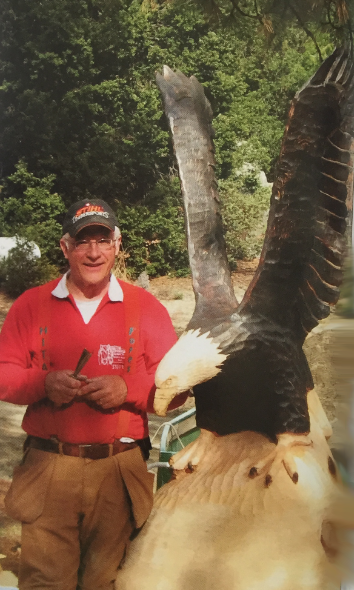
A while back, I made a fairly large carving and took some photos that will help guide you through the process when the day finally comes for you and it is no longer a “someday"—it is a “NOW!” There are a few things you should keep in mind. Understand, I’m not telling you not to do it. Far from it! Do it! But to really get the most out of doing it and to actually enjoy the process (which is what this is about, right?), you need to be aware of some things and prepare for them.
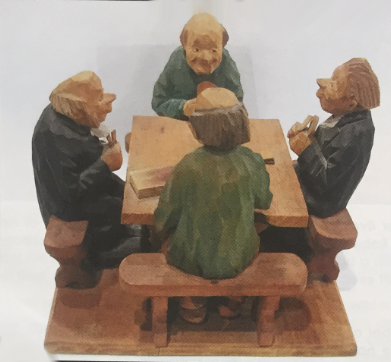
I had an unexpected treat a few months ago during one of my monthly club meetings. A fellow club member, Dick Zawacki, brought in a woodcarving that he had borrowed from a friend and thought that I might like to take a look at it. Normally, not much leaves me speechless, but what Dick showed me left me shocked beyond belief (and, yes, speechless!).
Welcome to Let’s Talk Carving, a column devoted to beginning and intermediate carvers. With only five years of carving, I’m the same as you—loving to carve, learning, and making mistakes. In every issue, we'll get together and I'll share what I’ve learned (TIPS), plus I'll often pass on nuggets of information gleaned from past issues of Carving Magazine.
Upon examining a figure carving by a student, the master carver noted that, while the detail was fairly well done, the carving was “still in the block."
He explained that some beginners are so preoccupied with quickly getting to the details that they don't give enough attention to fully shaping the figure itself; still others have a fear of removing too much wood with the result that they don't take away enough.
In each case, the outcome is a carving "still in the block." In much of his own work, the master carver took care that none of its planes were parallel to those of the original block of wood.
On the most fundamental level, getting a figure out of the block is accomplished by completely shaping the forms—"getting rid of the corners.” For example, real dogs don't have flat sides, but many amateur carvings of dogs do have flat sides.
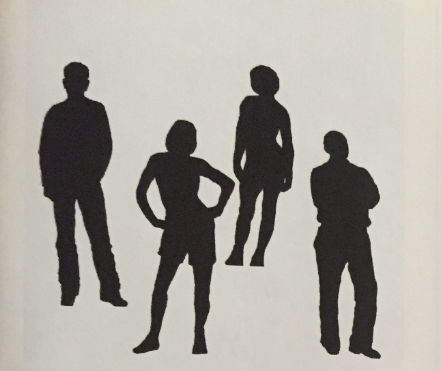
The fear of taking too much wood away leaves the carving still with the corners and the flat sides of the original block of wood. It's not only an issue with “realistic" carving. An incompletely carved caricature will often have flat sides, still reflective of the original block of wood.
Page 1 of 2
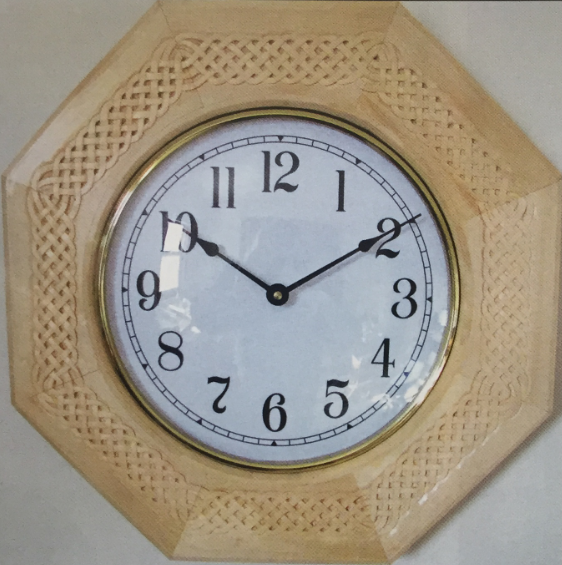
I have made a few very simple Celtic knots before and used them as ornamentation on woodwork. I usually placed them in the center of a panel or on a clock face. A commission for a wedding gift to an Irish couple gave me an excuse to take on a larger and more involved Celtic knot pattern. It is used as a border on the frame of a clock.
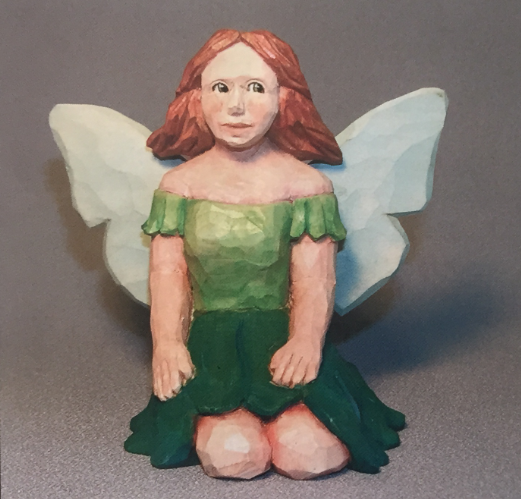
This fairy project is challenging because female features are quite often more difficult to carve than male features.
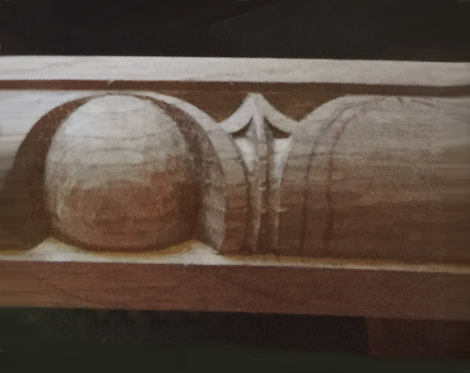
The egg and dart design originated in ancient Greek and Roman architecture, and can be seen in a variety of woodcarvings, stone carvings, and plaster castings. It contains an alternating design of an egg shape and a dart or arrow. This classical motif can be seen in many historical architectural designs.
Here is a challenging project brought to you by Desiree Hajny. The pattern is included in the pullout section; be sure to pay special attention to the hair flow and details.